


1783 John Hancock Twice Signed Revolutionary War Patriot Appointment, Grad Auth
- Regular price
-
$17,500.00 - Regular price
-
$0.00 - Sale price
-
$17,500.00
Couldn't load pickup availability
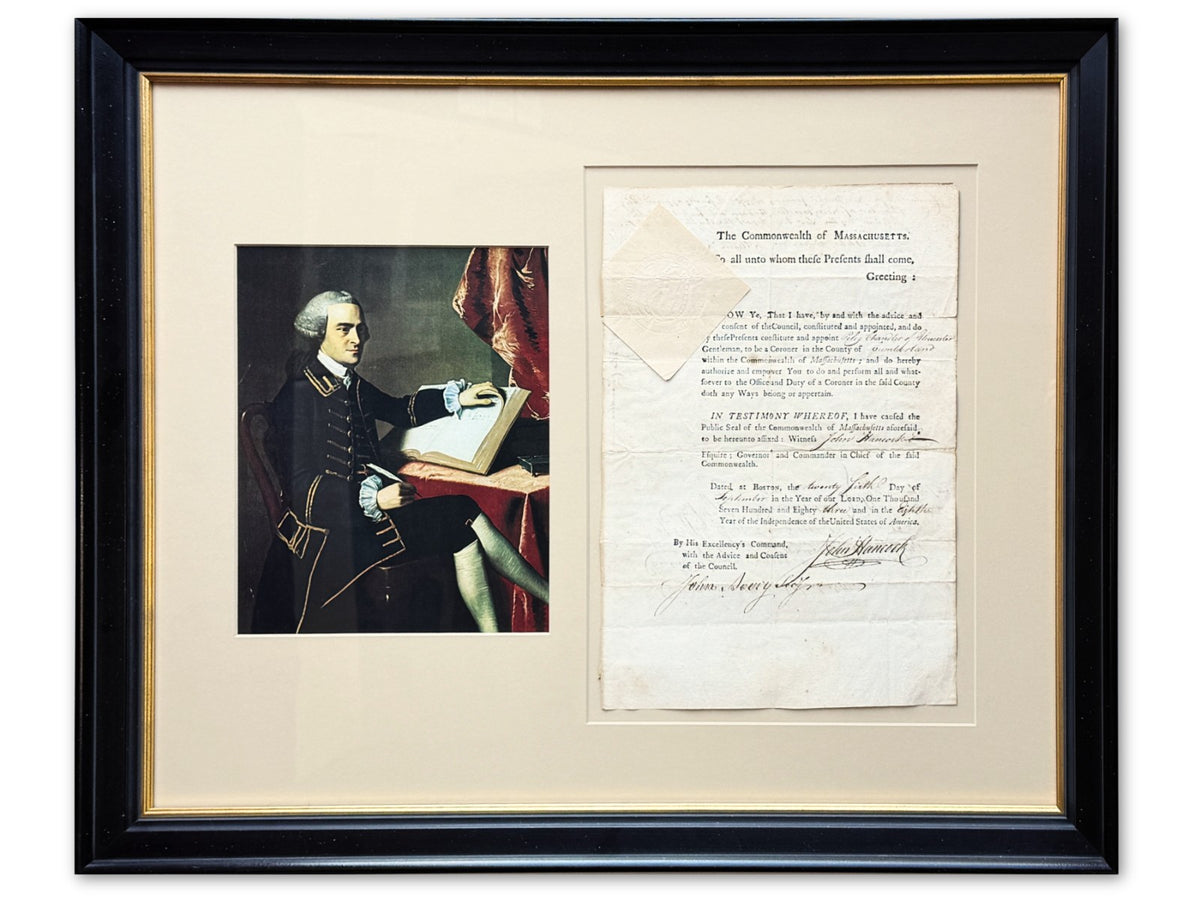
1783 John Hancock Twice-Signed Revolutionary War Document – Appointing Fellow Patriot Just 22 Days After the Treaty of Paris. Grad Authentic
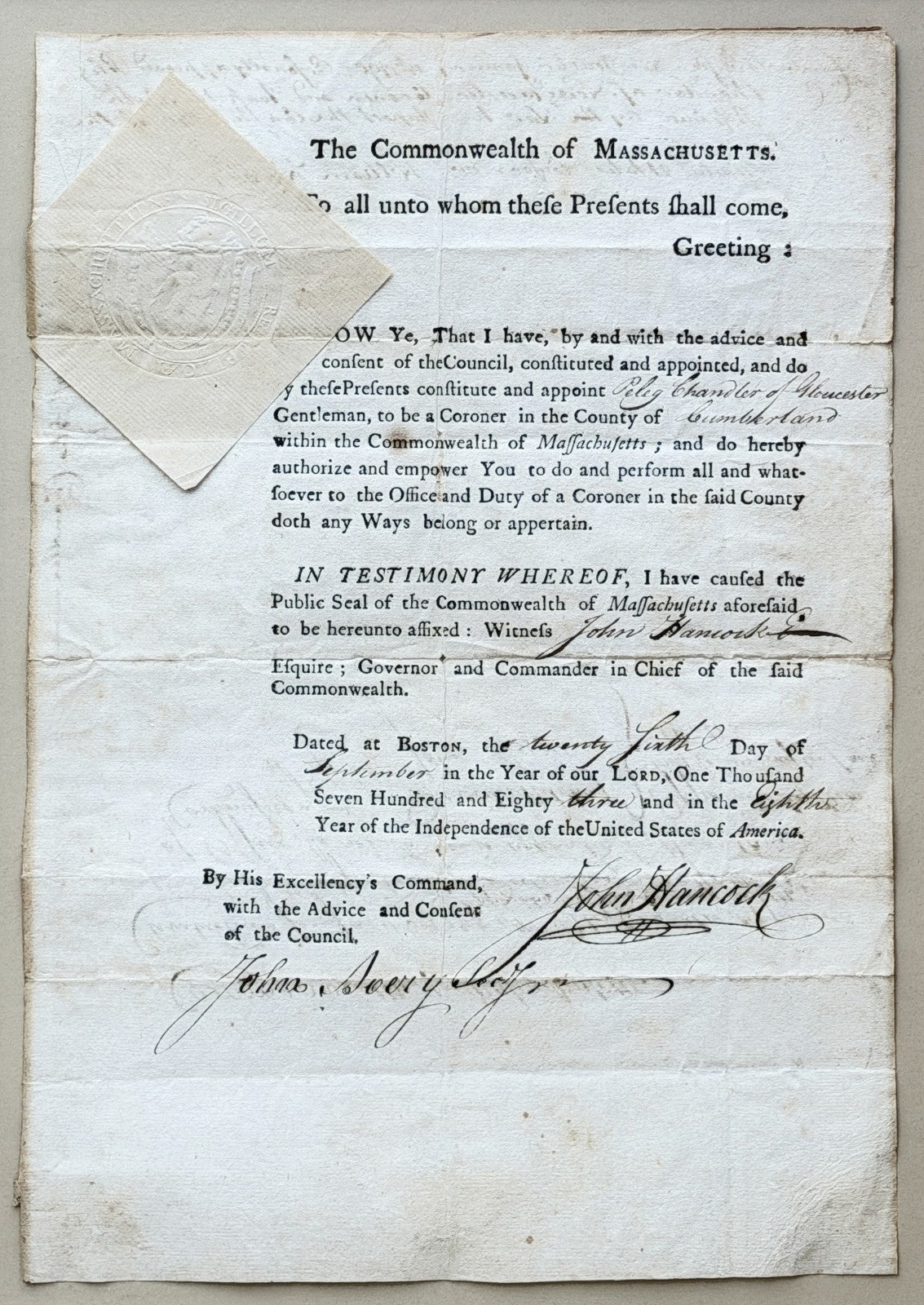
An extraordinary piece of early American history, signed twice by John Hancock, one of America's most celebrated Founding Fathers, the first signer of the Declaration of Independence, and a central figure in the American Revolution. Dated September 25, 1783, this official Massachusetts commission was issued just 22 days after the signing of the Treaty of Paris, which formally ended the Revolutionary War and officially recognized the United States as an independent nation.
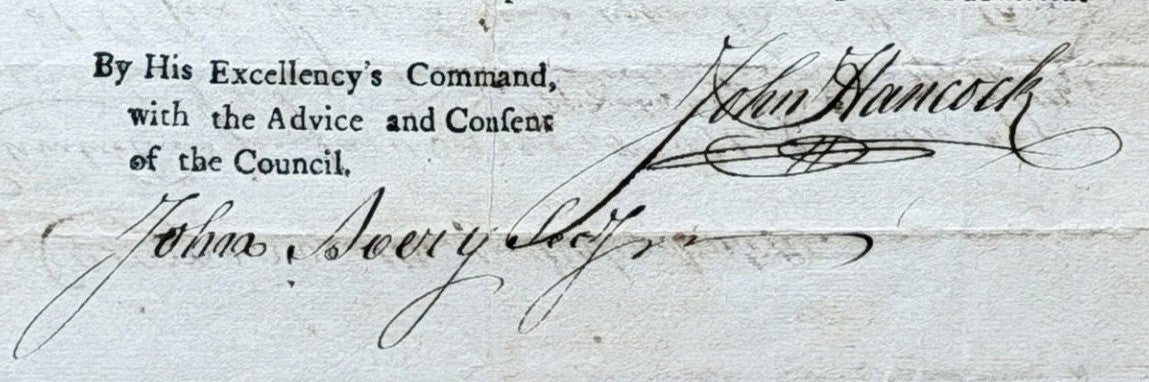
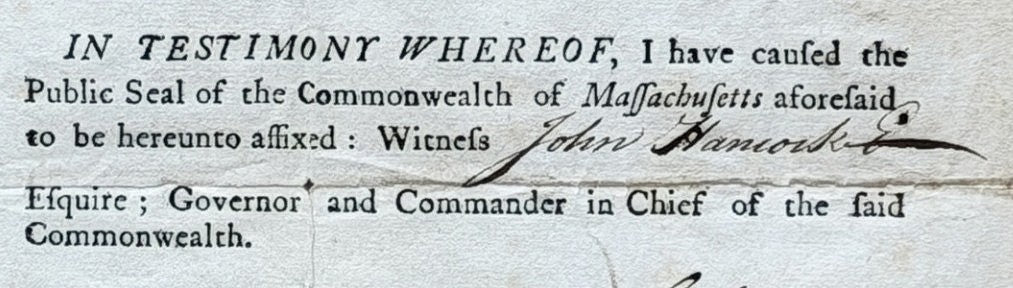
The impressive commission appoints Peleg Chandler as Coroner of Cumberland County and is printed on period paper. The document bears two original John Hancock signatures, along with the signature of Massachusetts Secretary John Avery Jr. and the embossed seal of the Commonwealth. Original folds, scattered toning, and minor age-related wear are present, with the document remaining remarkably attractive and perfectly legible after nearly two and a half centuries.
The magnificent John Hancock autograph is the true centerpiece of this historic document. Bold, oversized, and beautifully executed, the signature features the dramatic sweeping flourishes and unmistakable penmanship that have made Hancock's autograph the most famous in American history. This is precisely the type of large, commanding signature collectors seek, prominently displayed near the bottom of the commission, with a second Hancock signature appearing within the official witnessing clause.
Hancock's celebrated penmanship has become a symbol of American independence itself. According to famous legend, when signing the Declaration of Independence in 1776, Hancock deliberately wrote his name so large, flamboyant, and bold that King George III could read it without his spectacles. The story captures the spirit of defiance and confidence forever associated with his signature. So recognizable was his signature that the expression "John Hancock" became synonymous with a person's signature, a distinction unmatched by any other.
Even more compelling is the remarkable story of American independence woven into this historic document. This appointment document was issued to Peleg Chandler (1735–1819), a prominent Revolutionary War Patriot who helped lead local resistance against British rule. In 1776, just six weeks before the Declaration of Independence, Chandler's community, where he served among its Patriot leadership, pledged to support independence with their "lives and fortunes"—risking imprisonment, loss of property, and execution for treason. Coincidentally, John Hancock would make that same pledge, signing the Declaration of Independence beneath its famous closing words, "our Lives, our Fortunes and our sacred Honor." By September 1783, the American Revolution had reached its triumphant conclusion and three weeks later, Hancock, serving as Governor and Commander in Chief of Massachusetts, issued this commission appointing his fellow Patriot, Chandler.
Beyond his public service, Chandler was a skilled blacksmith and proprietor of the historic Bell Tavern, a gathering place for Patriots in Revolutionary-era Massachusetts. His tavern was a vital center of the independence movement, where militia members gathered, military intelligence was exchanged, and resistance to British rule was organized. As a local Patriot leader, Chandler was closely connected to these revolutionary activities, and his tavern provided a natural meeting place for the cause. Its original sign, still preserved by Chandler's descendants, proudly proclaimed "Success to the Friends of Liberty"—a bold and unmistakable declaration of allegiance to American independence while the colonies were still fighting for their freedom.
Few signatures are more immediately recognizable or historically consequential than John Hancock's, whose famously bold autograph on the Declaration of Independence has become synonymous with the very act of signing one's name. This exceptional commission offers far more than his celebrated autograph alone: two prominent Hancock signatures, an identified Revolutionary Patriot recipient, and a date falling within the first month of America's formally recognized independence. A remarkable surviving artifact from the birth of the United States and the transformation of thirteen rebellious colonies into a sovereign nation.
Both signatures are certified by Grad Authentic.